Search Result
Results for "
copper detection
" in MedChemExpress (MCE) Product Catalog:
2
Biochemical Assay Reagents
| Cat. No. |
Product Name |
Target |
Research Areas |
Chemical Structure |
-
- HY-D0813
-
|
|
Fluorescent Dye
|
Others
|
|
Zincon sodium is an excellent colorimetric reagent for the detection of zinc and copper ions in aqueous solution. Zincon sodium can be used for the determination of zinc, copper, and cobalt ions in metalloproteins .
|
-

-
- HY-W753658
-
|
|
Fluorescent Dye
|
Others
|
|
Coppersensor-3 (CS3) is a bright small-molecule fluorescent probe for selective Cu(I) detection. Coppersensor-3 is selective and sensitive enough to image labile copper pools in living cells at endogenous, basal levels. Coppersensor-3 can be used for the cell biology of copper research .
|
-

-
- HY-155639
-
|
|
Biochemical Assay Reagents
|
Others
|
|
Tyramide alkyne is an alternative labeling substrate that can be coupled to detection or enrichment moieties via a Copper-catalyzed Azide/Alkyne Cycloaddition (CuAAC) “click” reaction. Tyramide alkyne can be used for ascorbate peroxidase 2 (APEX2) labeling .
|
-

-
- HY-123645
-
|
|
Fluorescent Dye
|
Others
|
Rhodamine B hydrazide is a fluorescent derivative based on rhodamine B, containing the spirocyclic structure of Rhodamine B (HY-Y0016), which can be used to detect copper ions (Cu 2+), mercury ions, peroxynitrite, hydroxyl radicals and nitric oxide (NO) .
Excitation/emission wavelength:
Conventional detection: 510/578 nm.
Sulfite detection: 554 nm absorption, 574 nm emission (due to the formation of Rhodamine B fluorescent product).
|
-

-
- HY-12679
-
|
|
Btk
|
Cancer
|
|
PF-06658607 is an alkynylated irreversible Brutons tyrosine kinase (BTK) inhibitor that covalently reacts with active site cysteines in the ATP-binding pocket. PF-06658607 can be used to detect "off "-targets for covalent kinase inhibitors in cancer cells. The alkyne moiety allows for azide-based detection probe via copper-catalyzed click chemistry .
|
-

-
- HY-D2969
-
|
|
Fluorescent Dye
|
Metabolic Disease
|
|
CYDA is a colorimetric probe based on cyanine dyes, which enables highly sensitive and selective detection of Cu²⁺. CYDA can be used for urine copper detection in Wilson's disease .
|
-

-
- HY-W800697
-
|
|
Fluorescent Dye
|
Others
|
|
BP Fluor 430 Picolyl Azide is an advanced fluorescent probe that incorporatess a copper-chelating motif to raise the effective concentration of Cu(I) at the reaction site. The rate of the CuAAC reaction depends on the concentrations of all reagents, including copper, therefore raising the effective copper concentration at the reaction site will dramatically increase the rate of CuAAC reaction without the need to increase concentration of azide reagent or copper.
In addition, the use of BP Fluor 430 Picolyl Azide instead of conventional BP Fluor 430 Azide allows for at least a tenfold reduction in the concentration of the copper catalyst without sacrificing the efficiency of labeling.
In summary, the introduction of a picolyl moiety into an azide probe leads to a substantial increase in the sensitivity of alkyne detection. This is of special value for the detection of low abundance targets or where significant increase in signal intensity is desired.
|
-

-
- HY-W800693
-
|
|
Fluorescent Dye
|
Others
|
|
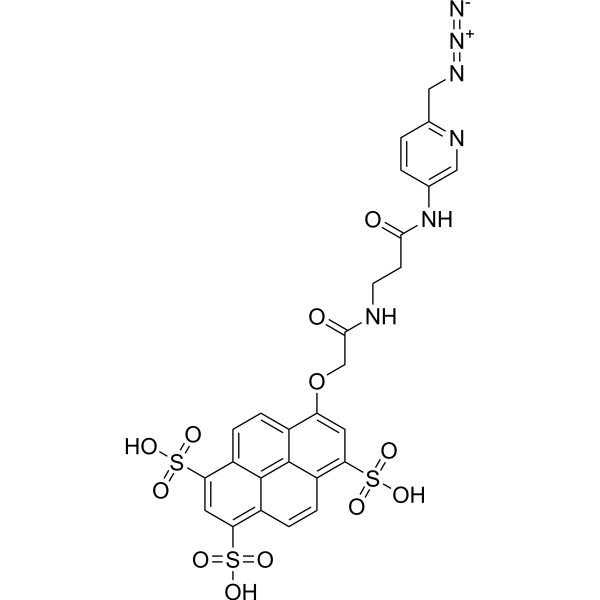
BP Fluor 405 Picolyl Azide is an advanced fluorescent probe that incorporatess a copper-chelating motif to raise the effective concentration of Cu(I) at the reaction site. The rate of the CuAAC reaction depends on the concentrations of all reagents, including copper, therefore raising the effective copper concentration at the reaction site dramatically increases the rate of CuAAC reaction without increasing the concentrations of azide reagent or copper.
In addition, the use of picolyl azide instead of conventional azides allows for at least a tenfold reduction in the concentration of the copper catalyst without sacrificing the efficiency of labeling.
In summary, the introduction of a picolyl moiety into an azide probe leads to a substantial increase in the sensitivity of alkyne detection. This is of special value for the detection of low abundance targets or where significant increase in signal intensity is desired.
|
-
-
- HY-W800694
-
|
|
Fluorescent Dye
|
Others
|
|
BP Fluor 405 alkyne triTEA is a blue-fluorescent dye that often used in multi-color applications, including flow cytometry and super-resolution microscopy using STORM. Its excitation is ideally suited for the 407 nm spectral line of the krypton laser or the 408 nm violet laser diode. BP Fluor 405 alkyne triTEA reacts with azides via a copper-catalyzed click reaction (CuAAC) to form a stable triazole linker. A probe for copper-less detection (BP Fluor 405 DBCO) is also available for application where the presence of copper is not acceptable.
|
-

-
- HY-D2230
-
|
|
Fluorescent Dye
|
Others
|
|
Cy3.5 alkyne, a fluorescent dye, is a click chemistry reagent, it contains an Alkyne group and can undergo copper-catalyzed azide-alkyne cycloaddition (CuAAc) with molecules containing Azide groups. Cy3.5 alkyne can be used for the detection and labeling of azide-containing molecules/ biomolecules with fluorescence spectroscopy after azide-alkyne cycloaddition .
|
-

-
- HY-155438
-
|
|
Fluorescent Dye
|
Others
|
|
Mal-Cz is a maltose-derived fluorescence-on imaging probe for the detection of E. coli and Staphylococcus aureus . It contains an Azide group and can undergo copper-catalyzed azide-alkyne cycloaddition reaction (CuAAc) with molecules containing Alkyne groups. It can also undergo strain-promoted alkyne-azide cycloaddition (SPAAC) reactions with molecules containing DBCO or BCN groups.
|
-

-
- HY-D1601
-
|
|
Fluorescent Dye
|
Others
|
|
N-Aminofluorescein is a fluorescein hydrazide with spiro form, a highly selective and sensitive fluorescence probe for Cu 2+. N-Aminofluorescein has no selective fluorescence response to other common metal ions, can be used for direct detection of Cu 2+ in biological systems with λex/em=495/516 nm . N-Aminofluorescein can be used to measure the concentration of copper ions in cells .
|
-

-
- HY-173390
-
|
|
Drug Intermediate
Biochemical Assay Reagents
|
Others
|
|
BCN-E-BCN is a strained cycloalkyne-based probe designed for detecting protein sulfenylation, the primary intermediate in protein oxidation. This structurally constrained cycloalkyne compound specifically recognizes sulfenic acid groups formed during thiol oxidation, while remaining completely unreactive toward other oxidative states (such as free thiols, sulfinic, or sulfonic acid groups). Researchers can leverage its efficient conjugation with azide-bearing tags through copper-free click chemistry to amplify detection signals. Compared to conventional detection methods, BCN-E-BCN demonstrates superior reaction kinetics and enhanced sensitivity. With these advantages, BCN-E-BCN shows great promise as an effective tool for protein oxidation research .
|
-

-
- HY-D1721
-
|
|
Fluorescent Dye
|
Others
|
|
Fluorescein-12-dATP is a fluorescent dye acting as the detection probe. Fluorescein-12-dATP can be used to label the thrombin-binding aptamers by catalytic polymerization of TdT (terminal deoxynucleotidyl transferase) . Fluorescein-12-dATP is a click chemistry reagent, it contains an Alkyne group and can undergo copper-catalyzed azide-alkyne cycloaddition (CuAAc) with molecules containing Azide groups.
|
-

-
- HY-137018
-
|
|
Biochemical Assay Reagents
|
Others
|
|
27-Alkyne cholesterol is a modified lipid containing an omega-terminal alkyne. The terminal alkyne group can be used in a highly specific linking reaction with azide-containing reagents, known as click chemistry, in the presence of a copper-containing catalyst.
Alkyne cholesterol represents a versatile, sensitive, and easy-to-use tool for tracking cellular cholesterol metabolism and localization as it allows for manifold detection methods including mass spectrometry, and fluorescence microscopy.
|
-

-
- HY-W110146
-
|
|
Biochemical Assay Reagents
|
Others
|
|
(3aS,4S,6aR)-Biotin-PEG4-Alkyne is an alkyne-activated biotinylation reagent. (3aS,4S,6aR)-Biotin-PEG4-Alkyne can be reacted with azides via a copper-catalyzed click reaction. Biotin-labeled biomolecules can be bound to avidin or streptavidin for further purification and detection .
|
-

-
- HY-141511
-
Coppersensor 1
Maximum Cited Publications
23 Publications Verification
|
Fluorescent Dye
|
Neurological Disease
Cancer
|
|
Coppersensor-1 (CS1) is a membrane-permeable fluorescent dye. Coppersensor-1 has a picomolar affinity for Cu + with high selectivity over competing cellular metalions. Coppersensor-1 as a probe, can selective and sensitive detection of copper(I) ions (Cu +) in biological samples, including live cells. Coppersensor-1 can be used for the research of imaging of severe diseases such as cancer, cardiovascular disorders and neurogenerative diseases .
|
-

-
- HY-W800696
-
|
|
Fluorescent Dye
|
Others
|
|
BP Fluor 430 Azide is a water-soluble, green-fluorescent, azide-activated probe that reacts with terminal alkynes via a copper-catalyzed click reaction (CuAAC). It also reacts with strained cyclooctyne via a copper-free click chemistry reaction to form a stable triazole and does not require a Cu-catalyst or elevated temperatures.
BP Fluor 430 is a bright, photostable, green-fluorescent probe with excitation near its absorption maximum at 432 nm and emission maximum at 539 nm. This probe is water soluble and pH-insensitive from pH 4 to pH 10.
A next generation probe, BP Fluor 430 Picolyl Azide, is also available for detection of low abundance alkyne-tagged biomolecules.
|
-

-
- HY-W423080
-
|
|
Biochemical Assay Reagents
Fluorescent Dye
|
Others
|
|
TAMRA alkyne, 5-isomer (Compound 3) is an alkyne derivative of TAMRA and can be used for the enrichment, in-gel fluorescence detection, and identification of O-GlcNAc-modified proteins. TAMRA alkyne, 5-isomer contains an Alkyne group and can undergo copper-catalyzed azide-alkyne cycloaddition reaction (CuAAc) with molecules containing Azide groups. It can also undergo strain-promoted alkyne-azide cycloaddition (SPAAC) reactions with molecules containing DBCO or BCN groups .
|
-

-
- HY-151855
-
|
|
ADC Linker
|
Others
|
|
Azido Myristic Acid is a click chemistry reagent containing an azide group. Azido Myristic Acid can be used to identify and characterize post-translationally myristylated proteins with using a simple and robust two-step labeling and detection technique . It contains an azide group and can undergo copper-catalyzed azide-alkyne cycloaddition (CuAAc) with molecules containing alkyne groups. It can also undergo ring strain-promoted alkyne-azide cycloaddition (SPAAC) with molecules containing DBCO or BCN groups.
|
-

-
- HY-W800702
-
|
|
Fluorescent Dye
|
Others
|
|
BP Fluor 555 Azide is a water-soluble, bright orange-fluorescent dye with excitation ideally suited for the 532 nm or 555 nm laser lines and visualized with TRITC (tetramethylrhodamine) filter sets. BP Fluor 555 conjugates of antibodies, peptides, and proteins are pH insensitive from pH 4 to pH 10. AF 555 conjugates ideally suited for detection of low abundance targets.
BP Fluor 555 Azide can be reacted with terminal alkynes via a copper-catalyzed click reaction (CuAAC). It also reacts with strained cyclooctyne via a copper-free “click chemistry” reaction to form a stable triazole and does not require Cu-catalyst or elevated temperatures. The brightness and photostability of this dye are best suited to direct imaging of low-abundance targets.
|
-

-
- HY-151656
-
|
Azido Palmitic Acid
|
ADC Linker
|
Others
|
|
15-Azido-pentadecanoic acid is a click chemistry reagent containing an azide group. Azido Palmitic Acid can be used to identify and characterize post-translationally palmitylated proteins with using a simple and robust two-step labeling and detection technique . 15-Azido-pentadecanoic acid is a click chemistry reagent, it contains an Azide group and can undergo copper-catalyzed azide-alkyne cycloaddition reaction (CuAAc) with molecules containing Alkyne groups. It can also undergo strain-promoted alkyne-azide cycloaddition (SPAAC) reactions with molecules containing DBCO or BCN groups.
|
-

-
- HY-D0027
-
|
Coumarin 120; AMC
|
Fluorescent Dye
Antibiotic
Fungal
|
Infection
|
|
7-Amino-4-methylcoumarin belongs to the coumarin class, can be isolated from the endophytic fungus Xylaria sp. and has a broad spectrum of antibacterial activity. 7-Amino-4-methylcoumarin is also commonly used as an important laser dye that emits in the blue region, capable of analyzing glycoprotein monosaccharides and N-linked oligosaccharides, and is also utilized in tissue pathology analysis, enzyme activity measurement, and copper ion detection. The excitation wavelength and emission wavelength are 351 nm and 430 nm, respectively.
|
-

-
- HY-D0027R
-
|
Coumarin 120 (Standard); AMC (Standard)
|
Fluorescent Dye
Antibiotic
Fungal
Reference Standards
|
Infection
|
|
7-Amino-4-methylcoumarin (Standard) is the analytical standard of 7-Amino-4-methylcoumarin. This product is intended for research and analytical applications. 7-Amino-4-methylcoumarin belongs to the coumarin class, can be isolated from the endophytic fungus Xylaria sp. and has a broad spectrum of antibacterial activity. 7-Amino-4-methylcoumarin is also commonly used as an important laser dye that emits in the blue region, capable of analyzing glycoprotein monosaccharides and N-linked oligosaccharides, and is also utilized in tissue pathology analysis, enzyme activity measurement, and copper ion detection. The excitation wavelength and emission wavelength are 351 nm and 430 nm, respectively. [4]
|
-

-
- HY-131455A
-
|
|
Biochemical Assay Reagents
|
Others
|
|
Biotin-C1-PEG3-C3-amido-C5-Gly-Arg-Gly-N3 TFA is used for detection of modification site for N-myristoylated and GPI-anchored proteins in blood-stage P. falciparum . Biotin-C1-PEG3-C3-amido-C5-Gly-Arg-Gly-N3 (TFA) is a click chemistry reagent, it contains an Azide group and can undergo copper-catalyzed azide-alkyne cycloaddition reaction (CuAAc) with molecules containing Alkyne groups. It can also undergo strain-promoted alkyne-azide cycloaddition (SPAAC) reactions with molecules containing DBCO or BCN groups.
|
-

-
- HY-W127719
-
|
|
Biochemical Assay Reagents
|
Others
|
|
Photobiotin (acetate)It is a biological probe used to study biochemical processes such as protein interactions and enzymatic reactions. It is a molecule containing a photosensitive group, which can be combined with specific target molecules (such as proteins, nucleic acids, etc.) through photochemical cross-linking technology, so as to realize the labeling and detection of these molecules. During the photosensitive crosslinking process, Photobiotin (acetate)Can participate in the formation of covalent bonds and form stable compounds. In addition, the compound also has high biocompatibility and biological activity, so it is widely used in the field of biomedical research, such as enzymatic research, proteomics, western blotting and other aspects. Photobiotin (acetate) is a click chemistry reagent, it contains an Azide group and can undergo copper-catalyzed azide-alkyne cycloaddition reaction (CuAAc) with molecules containing Alkyne groups. It can also undergo strain-promoted alkyne-azide cycloaddition (SPAAC) reactions with molecules containing DBCO or BCN groups.
|
-

| Cat. No. |
Product Name |
Type |
-
- HY-D0813
-
|
|
Fluorescent Dye
|
|
Zincon sodium is an excellent colorimetric reagent for the detection of zinc and copper ions in aqueous solution. Zincon sodium can be used for the determination of zinc, copper, and cobalt ions in metalloproteins .
|
-
- HY-123645
-
|
|
Fluorescent Dye
|
Rhodamine B hydrazide is a fluorescent derivative based on rhodamine B, containing the spirocyclic structure of Rhodamine B (HY-Y0016), which can be used to detect copper ions (Cu 2+), mercury ions, peroxynitrite, hydroxyl radicals and nitric oxide (NO) .
Excitation/emission wavelength:
Conventional detection: 510/578 nm.
Sulfite detection: 554 nm absorption, 574 nm emission (due to the formation of Rhodamine B fluorescent product).
|
-
- HY-D1601
-
|
|
Fluorescent Dye
|
|
N-Aminofluorescein is a fluorescein hydrazide with spiro form, a highly selective and sensitive fluorescence probe for Cu 2+. N-Aminofluorescein has no selective fluorescence response to other common metal ions, can be used for direct detection of Cu 2+ in biological systems with λex/em=495/516 nm . N-Aminofluorescein can be used to measure the concentration of copper ions in cells .
|
-
- HY-141511
-
|
|
Fluorescent Dye
|
|
Coppersensor-1 (CS1) is a membrane-permeable fluorescent dye. Coppersensor-1 has a picomolar affinity for Cu + with high selectivity over competing cellular metalions. Coppersensor-1 as a probe, can selective and sensitive detection of copper(I) ions (Cu +) in biological samples, including live cells. Coppersensor-1 can be used for the research of imaging of severe diseases such as cancer, cardiovascular disorders and neurogenerative diseases .
|
-
- HY-D2969
-
|
|
Fluorescent Dye
|
|
CYDA is a colorimetric probe based on cyanine dyes, which enables highly sensitive and selective detection of Cu²⁺. CYDA can be used for urine copper detection in Wilson's disease .
|
-
- HY-W800697
-
|
|
Fluorescent Dye
|
|
BP Fluor 430 Picolyl Azide is an advanced fluorescent probe that incorporatess a copper-chelating motif to raise the effective concentration of Cu(I) at the reaction site. The rate of the CuAAC reaction depends on the concentrations of all reagents, including copper, therefore raising the effective copper concentration at the reaction site will dramatically increase the rate of CuAAC reaction without the need to increase concentration of azide reagent or copper.
In addition, the use of BP Fluor 430 Picolyl Azide instead of conventional BP Fluor 430 Azide allows for at least a tenfold reduction in the concentration of the copper catalyst without sacrificing the efficiency of labeling.
In summary, the introduction of a picolyl moiety into an azide probe leads to a substantial increase in the sensitivity of alkyne detection. This is of special value for the detection of low abundance targets or where significant increase in signal intensity is desired.
|
-
- HY-W800693
-
|
|
Fluorescent Dye
|
|
BP Fluor 405 Picolyl Azide is an advanced fluorescent probe that incorporatess a copper-chelating motif to raise the effective concentration of Cu(I) at the reaction site. The rate of the CuAAC reaction depends on the concentrations of all reagents, including copper, therefore raising the effective copper concentration at the reaction site dramatically increases the rate of CuAAC reaction without increasing the concentrations of azide reagent or copper.
In addition, the use of picolyl azide instead of conventional azides allows for at least a tenfold reduction in the concentration of the copper catalyst without sacrificing the efficiency of labeling.
In summary, the introduction of a picolyl moiety into an azide probe leads to a substantial increase in the sensitivity of alkyne detection. This is of special value for the detection of low abundance targets or where significant increase in signal intensity is desired.
|
-
- HY-W800694
-
|
|
Fluorescent Dye
|
|
BP Fluor 405 alkyne triTEA is a blue-fluorescent dye that often used in multi-color applications, including flow cytometry and super-resolution microscopy using STORM. Its excitation is ideally suited for the 407 nm spectral line of the krypton laser or the 408 nm violet laser diode. BP Fluor 405 alkyne triTEA reacts with azides via a copper-catalyzed click reaction (CuAAC) to form a stable triazole linker. A probe for copper-less detection (BP Fluor 405 DBCO) is also available for application where the presence of copper is not acceptable.
|
-
- HY-D2230
-
|
|
Fluorescent Dye
|
|
Cy3.5 alkyne, a fluorescent dye, is a click chemistry reagent, it contains an Alkyne group and can undergo copper-catalyzed azide-alkyne cycloaddition (CuAAc) with molecules containing Azide groups. Cy3.5 alkyne can be used for the detection and labeling of azide-containing molecules/ biomolecules with fluorescence spectroscopy after azide-alkyne cycloaddition .
|
-
- HY-155438
-
|
|
Fluorescent Dye
|
|
Mal-Cz is a maltose-derived fluorescence-on imaging probe for the detection of E. coli and Staphylococcus aureus . It contains an Azide group and can undergo copper-catalyzed azide-alkyne cycloaddition reaction (CuAAc) with molecules containing Alkyne groups. It can also undergo strain-promoted alkyne-azide cycloaddition (SPAAC) reactions with molecules containing DBCO or BCN groups.
|
-
- HY-W800696
-
|
|
Fluorescent Dye
|
|
BP Fluor 430 Azide is a water-soluble, green-fluorescent, azide-activated probe that reacts with terminal alkynes via a copper-catalyzed click reaction (CuAAC). It also reacts with strained cyclooctyne via a copper-free click chemistry reaction to form a stable triazole and does not require a Cu-catalyst or elevated temperatures.
BP Fluor 430 is a bright, photostable, green-fluorescent probe with excitation near its absorption maximum at 432 nm and emission maximum at 539 nm. This probe is water soluble and pH-insensitive from pH 4 to pH 10.
A next generation probe, BP Fluor 430 Picolyl Azide, is also available for detection of low abundance alkyne-tagged biomolecules.
|
-
- HY-W800702
-
|
|
Fluorescent Dye
|
|
BP Fluor 555 Azide is a water-soluble, bright orange-fluorescent dye with excitation ideally suited for the 532 nm or 555 nm laser lines and visualized with TRITC (tetramethylrhodamine) filter sets. BP Fluor 555 conjugates of antibodies, peptides, and proteins are pH insensitive from pH 4 to pH 10. AF 555 conjugates ideally suited for detection of low abundance targets.
BP Fluor 555 Azide can be reacted with terminal alkynes via a copper-catalyzed click reaction (CuAAC). It also reacts with strained cyclooctyne via a copper-free “click chemistry” reaction to form a stable triazole and does not require Cu-catalyst or elevated temperatures. The brightness and photostability of this dye are best suited to direct imaging of low-abundance targets.
|
-
- HY-D0027
-
|
Coumarin 120; AMC
|
Fluorescent Dye
|
|
7-Amino-4-methylcoumarin belongs to the coumarin class, can be isolated from the endophytic fungus Xylaria sp. and has a broad spectrum of antibacterial activity. 7-Amino-4-methylcoumarin is also commonly used as an important laser dye that emits in the blue region, capable of analyzing glycoprotein monosaccharides and N-linked oligosaccharides, and is also utilized in tissue pathology analysis, enzyme activity measurement, and copper ion detection. The excitation wavelength and emission wavelength are 351 nm and 430 nm, respectively.
|
-
- HY-D0027R
-
|
Coumarin 120 (Standard); AMC (Standard)
|
Fluorescent Dye
|
|
7-Amino-4-methylcoumarin (Standard) is the analytical standard of 7-Amino-4-methylcoumarin. This product is intended for research and analytical applications. 7-Amino-4-methylcoumarin belongs to the coumarin class, can be isolated from the endophytic fungus Xylaria sp. and has a broad spectrum of antibacterial activity. 7-Amino-4-methylcoumarin is also commonly used as an important laser dye that emits in the blue region, capable of analyzing glycoprotein monosaccharides and N-linked oligosaccharides, and is also utilized in tissue pathology analysis, enzyme activity measurement, and copper ion detection. The excitation wavelength and emission wavelength are 351 nm and 430 nm, respectively. [4]
|
| Cat. No. |
Product Name |
Type |
-
- HY-131455A
-
|
|
Biochemical Assay Reagents
|
|
Biotin-C1-PEG3-C3-amido-C5-Gly-Arg-Gly-N3 TFA is used for detection of modification site for N-myristoylated and GPI-anchored proteins in blood-stage P. falciparum . Biotin-C1-PEG3-C3-amido-C5-Gly-Arg-Gly-N3 (TFA) is a click chemistry reagent, it contains an Azide group and can undergo copper-catalyzed azide-alkyne cycloaddition reaction (CuAAc) with molecules containing Alkyne groups. It can also undergo strain-promoted alkyne-azide cycloaddition (SPAAC) reactions with molecules containing DBCO or BCN groups.
|
-
- HY-W127719
-
|
|
Biochemical Assay Reagents
|
|
Photobiotin (acetate)It is a biological probe used to study biochemical processes such as protein interactions and enzymatic reactions. It is a molecule containing a photosensitive group, which can be combined with specific target molecules (such as proteins, nucleic acids, etc.) through photochemical cross-linking technology, so as to realize the labeling and detection of these molecules. During the photosensitive crosslinking process, Photobiotin (acetate)Can participate in the formation of covalent bonds and form stable compounds. In addition, the compound also has high biocompatibility and biological activity, so it is widely used in the field of biomedical research, such as enzymatic research, proteomics, western blotting and other aspects. Photobiotin (acetate) is a click chemistry reagent, it contains an Azide group and can undergo copper-catalyzed azide-alkyne cycloaddition reaction (CuAAc) with molecules containing Alkyne groups. It can also undergo strain-promoted alkyne-azide cycloaddition (SPAAC) reactions with molecules containing DBCO or BCN groups.
|
| Cat. No. |
Product Name |
|
Classification |
-
- HY-W110146
-
|
|
|
Labeling and Fluorescence Imaging
|
|
(3aS,4S,6aR)-Biotin-PEG4-Alkyne is an alkyne-activated biotinylation reagent. (3aS,4S,6aR)-Biotin-PEG4-Alkyne can be reacted with azides via a copper-catalyzed click reaction. Biotin-labeled biomolecules can be bound to avidin or streptavidin for further purification and detection .
|
-
- HY-W423080
-
|
|
|
Alkynes
|
|
TAMRA alkyne, 5-isomer (Compound 3) is an alkyne derivative of TAMRA and can be used for the enrichment, in-gel fluorescence detection, and identification of O-GlcNAc-modified proteins. TAMRA alkyne, 5-isomer contains an Alkyne group and can undergo copper-catalyzed azide-alkyne cycloaddition reaction (CuAAc) with molecules containing Azide groups. It can also undergo strain-promoted alkyne-azide cycloaddition (SPAAC) reactions with molecules containing DBCO or BCN groups .
|
-
- HY-151855
-
|
|
|
Azide
Labeling and Fluorescence Imaging
|
|
Azido Myristic Acid is a click chemistry reagent containing an azide group. Azido Myristic Acid can be used to identify and characterize post-translationally myristylated proteins with using a simple and robust two-step labeling and detection technique . It contains an azide group and can undergo copper-catalyzed azide-alkyne cycloaddition (CuAAc) with molecules containing alkyne groups. It can also undergo ring strain-promoted alkyne-azide cycloaddition (SPAAC) with molecules containing DBCO or BCN groups.
|
-
- HY-151656
-
|
Azido Palmitic Acid
|
|
Azide
Labeling and Fluorescence Imaging
|
|
15-Azido-pentadecanoic acid is a click chemistry reagent containing an azide group. Azido Palmitic Acid can be used to identify and characterize post-translationally palmitylated proteins with using a simple and robust two-step labeling and detection technique . 15-Azido-pentadecanoic acid is a click chemistry reagent, it contains an Azide group and can undergo copper-catalyzed azide-alkyne cycloaddition reaction (CuAAc) with molecules containing Alkyne groups. It can also undergo strain-promoted alkyne-azide cycloaddition (SPAAC) reactions with molecules containing DBCO or BCN groups.
|
-
- HY-131455A
-
|
|
|
Azide
|
|
Biotin-C1-PEG3-C3-amido-C5-Gly-Arg-Gly-N3 TFA is used for detection of modification site for N-myristoylated and GPI-anchored proteins in blood-stage P. falciparum . Biotin-C1-PEG3-C3-amido-C5-Gly-Arg-Gly-N3 (TFA) is a click chemistry reagent, it contains an Azide group and can undergo copper-catalyzed azide-alkyne cycloaddition reaction (CuAAc) with molecules containing Alkyne groups. It can also undergo strain-promoted alkyne-azide cycloaddition (SPAAC) reactions with molecules containing DBCO or BCN groups.
|
-
- HY-W800694
-
|
|
|
Alkynes
|
|
BP Fluor 405 alkyne triTEA is a blue-fluorescent dye that often used in multi-color applications, including flow cytometry and super-resolution microscopy using STORM. Its excitation is ideally suited for the 407 nm spectral line of the krypton laser or the 408 nm violet laser diode. BP Fluor 405 alkyne triTEA reacts with azides via a copper-catalyzed click reaction (CuAAC) to form a stable triazole linker. A probe for copper-less detection (BP Fluor 405 DBCO) is also available for application where the presence of copper is not acceptable.
|
-
- HY-D2230
-
|
|
|
Alkynes
|
|
Cy3.5 alkyne, a fluorescent dye, is a click chemistry reagent, it contains an Alkyne group and can undergo copper-catalyzed azide-alkyne cycloaddition (CuAAc) with molecules containing Azide groups. Cy3.5 alkyne can be used for the detection and labeling of azide-containing molecules/ biomolecules with fluorescence spectroscopy after azide-alkyne cycloaddition .
|
-
- HY-155438
-
|
|
|
Azide
|
|
Mal-Cz is a maltose-derived fluorescence-on imaging probe for the detection of E. coli and Staphylococcus aureus . It contains an Azide group and can undergo copper-catalyzed azide-alkyne cycloaddition reaction (CuAAc) with molecules containing Alkyne groups. It can also undergo strain-promoted alkyne-azide cycloaddition (SPAAC) reactions with molecules containing DBCO or BCN groups.
|
-
- HY-137018
-
|
|
|
Alkynes
|
|
27-Alkyne cholesterol is a modified lipid containing an omega-terminal alkyne. The terminal alkyne group can be used in a highly specific linking reaction with azide-containing reagents, known as click chemistry, in the presence of a copper-containing catalyst.
Alkyne cholesterol represents a versatile, sensitive, and easy-to-use tool for tracking cellular cholesterol metabolism and localization as it allows for manifold detection methods including mass spectrometry, and fluorescence microscopy.
|
-
- HY-W127719
-
|
|
|
Azide
|
|
Photobiotin (acetate)It is a biological probe used to study biochemical processes such as protein interactions and enzymatic reactions. It is a molecule containing a photosensitive group, which can be combined with specific target molecules (such as proteins, nucleic acids, etc.) through photochemical cross-linking technology, so as to realize the labeling and detection of these molecules. During the photosensitive crosslinking process, Photobiotin (acetate)Can participate in the formation of covalent bonds and form stable compounds. In addition, the compound also has high biocompatibility and biological activity, so it is widely used in the field of biomedical research, such as enzymatic research, proteomics, western blotting and other aspects. Photobiotin (acetate) is a click chemistry reagent, it contains an Azide group and can undergo copper-catalyzed azide-alkyne cycloaddition reaction (CuAAc) with molecules containing Alkyne groups. It can also undergo strain-promoted alkyne-azide cycloaddition (SPAAC) reactions with molecules containing DBCO or BCN groups.
|
Your information is safe with us. * Required Fields.
Inquiry Information
- Product Name:
- Cat. No.:
- Quantity:
- MCE Japan Authorized Agent: